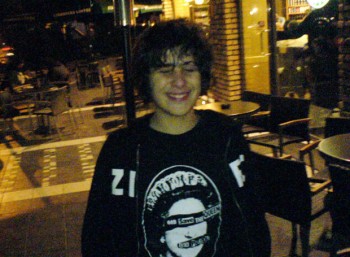
This isn’t a political statement.
Just kidding, of course it is – nothing is apolitical. Even silence is complicity. What this piece isn’t, however, is a meticulously constructed account aiming to take a specific stance in the service of a particular agenda. No, no, quite the contrary. I have had enough of those willing to bend the truth to its absolute limits so that they can shoehorn it into a premade box. I have also had enough of people sealing their ears and eyes to inconvenience. The truth has flaws and it doesn’t always make sense; it’s never well-plotted, well-thought, or well-written. It is what it is.
Sixteen years since the 2008 Greek Riots you were murdered
I am in Athens for four nights, and as luck would have it so are two of my most fun old schoolmates. We meet in Kolonaki for convenience – the Chelsea of Athens for those who don’t know – pretending we’re old and that we’ll have an early night. When that plan inevitably fails, we find ourselves crossing into the ‘infamous’ Exarcheia seeking familiarity and non-extortionate alcohol prices. I immediately start moaning – half-jokingly – about how much the area has changed. Kolonaki has been steadily spilling past its assigned border, the main proof that I am in Exarcheia is the street names, and the pairs of riot police casually dotted around. My heart quickens when I see them but that’s just an impulsive reaction. I’m a thirty-year-old lady now, wearing artisan trainers disguised as artsy brogues so that I can walk long distances in style. They don’t even bat an eye when I make eye contact. I still hate them as much as I fear them.
Another familiar road name. Oh no. How long has it been that I only realise where I am after stepping on the exact spot?
I’ve lost many people since 2008. People who were actually close to me, most recently my father. And my mates have experienced loss too. I am not going to stand here and make a big deal out of this. I acknowledge your memorial, and that’s enough. I won’t dwell on the past. There is nothing I can do that isn’t performative. Let’s just go find a place that stays open past one am on a Sunday and get another drink.
But the next day, I come back.
In daylight, the gentrification of Exarcheia is even more striking. It is still known as the anarchist quarter of Athens, but the rise in the number of cafes selling tri-colour quinoa salads and avocado on toast is quite alarming. A scribble on a wall reads, ‘Fuck Airbnb clients’. I see tourists photograph it for Instagram and wonder where the fuck they’re staying.
I find a florist and ask for three roses. She asks if they are a gift and if she should wrap them in nice paper. I’m not sure why, but I tell her not to bother, so she just ties them with a piece of string. It’s good. They look more beautiful this way. They smell nice too… can’t believe they were only four euros fifty. Fifteen years ago, a friend of mine was sold a single rose for ten euros just a few streets away; I guess Exarcheia is still standing its ground.
And so I arrive at the spot. The junction of two roads whose names when said together carry meaning that erases the years they existed before your blood was shed here. Posters upon posters and graffiti upon graffiti, just like it used to be, but the conversations of people sipping freddo espressos make it all feel staged. Yes, the politically charged murals were here first, but I am not convinced they would be here still if someone wasn’t capitalising on them. I hope I’m wrong.
There’s already a red rose wedged behind the plaque of your memorial with some life still left in it. I set my three on the top of the concrete structure and glance up at the young magnolia tree it houses. After I read and re-read the inscription and further commemorative text on the wall behind, I take a seat on a low, spherical bollard and just exist for a bit.
I know I don’t belong here. I left. Over twelve years ago. I wonder if you, too, would have moved abroad, either straight after school or maybe later. I wonder if I would have stayed had you not been murdered, or at least if the adults around me had reacted differently. Would either of us ever return to this place had that night gone differently? Where would your friend be now? You know who I mean.
I watch people going about their day, and my initial reaction is to get angry at those walking past your memorial without glancing at it. What’s on their minds? Do they know your story? Which version? How many of them are on their way to or from work, running errands, living their lives, while I demand they pay you the same attention as I do? Did my flowers attract any of those who stop and read, or would they have stopped either way? Do any of them stop daily while my unconscious is trying to make up for the years of absence by locking my limbs in place?
This is the year the scales tip. You were fifteen then, and now it’s been sixteen years.
When I google your name later, I am relieved that at least one lie has disappeared for good from the first page of the search results. The lie that you were sixteen when your life was taken from you. Back then, I could not wrap my head around it – it was December 2008, and you were born in 1993; people didn’t even need to know your exact birthday to get the math right. The only alternative was that you were still fourteen for a few more days.
Now I laugh at my innocence. This was never about poor math. A sixteen-year-old is a young man, not a child. And, unlike a child who is always innocent, a young man can be a troublemaker, a menace – a terrorist.
The lies that spread and continue to spread about you had me questioning my own sanity. The state, the media, and the police, all willing to desecrate an innocent person’s memory to protect their own interests. Concrete proof ignored and buried. And when they could no longer come after you – when all their lies and false claims fell flat, refuted by any and every person who had ever interacted with you – they went after your friend.
The lucky one. The one who held you as you bled. The one who lost everything that night but his beating heart. Because you see, he got to become a man, and men don’t get the same sympathy as boys. Sixteen years later, they continue smearing his name and your memory with it. Thinking we won’t notice what they’re doing. How they continuously allude to the fact that any allegations against him could have been yours. That yes, you were a child then, but had they let you grow up, you would have become a troublemaker, a menace – a terrorist. So, you know, it’s not the end of the world that they didn’t.
From the first moment I said I won’t forgive and I won’t forget. My defiance flared and burned, fuelled by rage, anger, and a desire to be taken fucking seriously. But I feared I would. Every single day, I feared I would forget, and I didn’t know how I could live with myself if I did. So, I fixed a t-shirt. Got one specially made at a printshop in the basement of a 2000s mall.
ΔΕΝ ΞΕΧΝΩ
I don’t forget.
I wore it every day for four months. Got back from school, handwashed it in a bucket with soapy water, and hung it over the radiator, crossing my fingers it’d be dry by morning. A handful of times, it was still damp. But fuck it, I wore it anyway. When I decided it was time to retire it, I hung it on my wall, and for the first few years, I reverently wore it on the 6th of December. But the years passed, and I stopped doing this. I worried it would be perceived wrongly, afraid I might be teased or accused of seeking attention. This did happen once or twice. I still switched my Facebook profile picture to a solid black one, though. Other people were doing this too, so it was okay.
More years passed. I don’t always change my profile picture anymore, only if I feel like it. I am safe. I am 1,594 miles away from Athens and closer to my forties than being back at school. I no longer need to shout about the fact that I don’t and won’t forgive or forget because I finally realise that no one cares for my forgiveness and that forgetting is impossible. Every time I hear about police brutality; injustice; government corruption; twisted truths; media manipulation, I think of you. Every time someone refuses to listen to first-hand accounts but prefers to take comfort in manufactured ones, I think of you. Every Christmas, I think of you. Every time I listen to the Sex Pistols, I think of you. Every time I drink a Starbucks, I think of you. Every time someone asks me what made me move to the UK – I never say it – but I think of you. I think of you more than I realise because I have been doing it for too long.
Back in Bristol, I open to read the things I wrote in those first emotionally charged months and first few years. Songs and dedications to you. Angry posts and calls to action. I worry I will cringe as I often do when reading old material. Instead, I start bawling. Don’t get me wrong, most of it is bloody terrible. The reason I’m crying is because I am pulled back into that time and realise that I am still as confused and angry as I was then.
The night before, you were at my house. Briefly. By chance. I won’t pretend we were close friends, much more than two kids who knew each other’s names. I was nothing to you. The friend of a friend, who had agreed to take in a puppy for a day, and you’d both come to drop it off. I perform for your benefit because I’m shy, jokingly kicking our mutual friend out because I’m done with her shenanigans, then smiling at you as I say, ‘Not you, you can stay!’ Throwaway words that I wouldn’t remember in a million years if subsequent events hadn’t etched them into my memory. Eventually, you both leave so I can get on with my German lesson. Pointless, really, I still can’t speak a word of German.
As I write this now, I find it hard to believe I am not making things up. Twenty-four hours later, I’m outside a bar that sells alcohol to minors, a stone’s throw away from our houses in Palaio Psychiko (the Hampstead of Athens, if we’re still doing this). I’m calling our mutual friend on the phone because that puppy is still at my house, and my mum is not happy. I must have been on my fifth or sixth attempt when another friend runs outside to tell me you’ve been shot. As I am ready to hang up, I hear the call answered.
No, I do not mention the puppy. Reality has warped and I think I am in a movie, so I speak my lines. I hear myself say that ‘they shot you’, and it sounds false because A. who’s ‘they’? And B., where’s the emotion? Shouldn’t a line like this be delivered with emotion?
Dissociation was not a concept I was familiar with at fourteen.
This is when I realise I won’t get through everything I hoped I would. The sleepless nights, the riots that were at first about you and slowly became about anything but you. The lady at your funeral asking the girl by your side to move because there is an endless queue of people waiting to see you. My stomach still twists, and I nearly vomit when I remember your sister mouthing who she was, then having to repeat herself louder so that she’s allowed to stay. That arsehole goody-two-shoes at our school’s Christmas fair thinking he could bully me into stopping the distribution of A4 pages requesting the disarming of the police force, telling me I am not allowed to distribute ‘protest flyers’, and when I tell him to shove it, coming back smugly with a teacher in tow who explains to me that some parents might ‘get upset’. I am so confused. How is anyone not on our side here? Do these parents not understand just how easily it could have been their own child in your place? I don’t expect empathy but fear, and yet I don’t even get that because somehow people have no problem convincing themselves that something doesn’t concern them even when it’s staring them in the eyes.
I have so much more to say, but what’s the rush? I’m sure I’ll find the time to continue this piece in the future. As I said, forgetting is impossible.
Εις το επανιδείν.
Until we meet again.
His name was Alexandros Grigoropoulos. His friends called him Gregory. On the 6th of December 2008, he was 15 years old when he was murdered by a special officer of the Greek police force.
 Arghierenia Kyrimi
Leave a comment